Why your AI works better in plain text
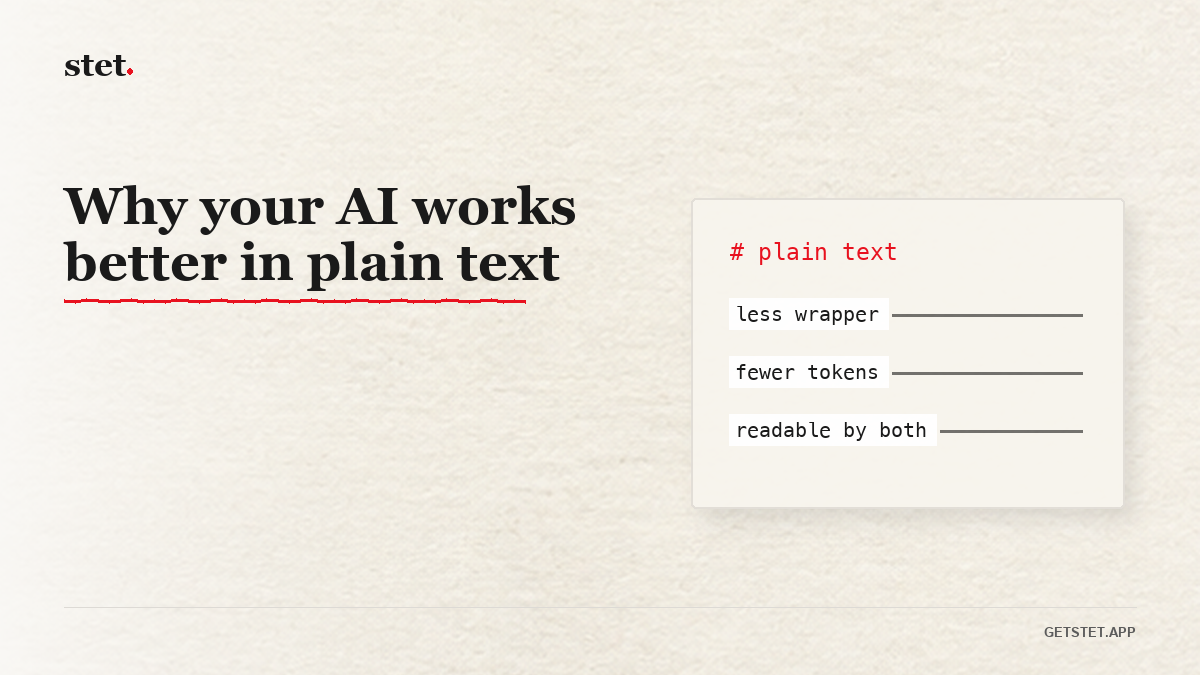
You moved some docs into markdown. Maybe for the agent, maybe just to get out of a tool you were tired of (looking at you, Jira). And the AI got noticeably better at working in them. That’s a happy little accident of markdown, and one other formats have a hard time recreating.
Markdown is structure without the noise
Markdown is "structured enough for machines and simple enough for humans," as Mark Chen put it. That balance is what makes it such a good shared surface for you and an AI. You can read it in any text editor and write it without learning much. An agent gets headings, lists, links, and emphasis without having to dig them out of a proprietary format.
That lighter structure matters because an agent reads your document as tokens, and every token takes up room. A Notion export or an HTML page carries tags, menus, class names, and wrapper divs that the model cannot use and still has to read. The same page in markdown drops most of that noise and keeps the part that matters. The agent reaches your actual words faster, with less clutter to get lost in.
Git was built for exactly this
Put those plain files on git and you get a system designed for change. Every edit is a diff. You can see what moved, roll back to last week with one command, and trace any line to the commit that wrote it. See it, change it, blame it when something breaks.
This is why the pattern keeps showing up everywhere agents do serious work. Prompts, specs, and agent configs are landing in repos, getting reviewed, and rolling back with a revert, the same as code. Plain text on git is quietly becoming the substrate the whole thing runs on.
The catch, if you are not an engineer
All of that is true, and all of it was built for people who read code for a living. If you are a writer or a PM, you get the good parts of the move (plain files, no lock-in, an agent that can actually read your work) and you lose something you had in Google Docs and Word. The review layer. Suggesting mode. Comments. Seeing a change before it becomes yours.
That is the gap Stet fills. It opens your plain markdown and puts the review layer back on top. An agent edit, or a teammate's pushed change, arrives as a proposal. You see what changed, you accept or reject it, and the file stays plain markdown on your machine the whole time.
The format won for good reasons. You should get to use it without giving up review.